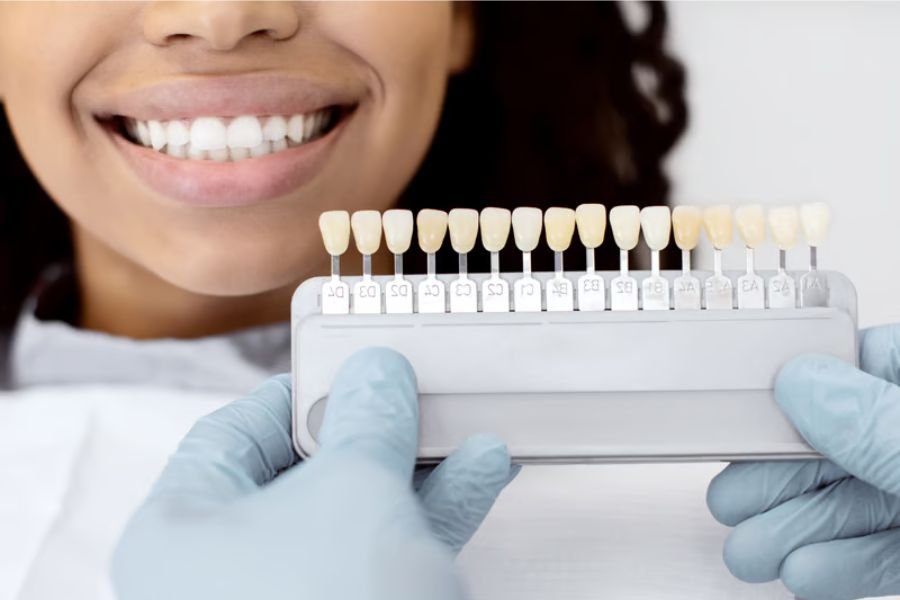
Patients researching smile makeovers almost always land on the same fork in the road: veneers or crowns? The two get lumped together often enough online that it’s easy to assume they’re interchangeable. They’re not, and picking the wrong one for your case can mean paying for more treatment than you actually needed or less than what your teeth require.
A veneer is a thin shell, usually porcelain, bonded to the front surface of a tooth. It’s designed to change how a tooth looks its shape, colour, or minor alignment issues without needing to remove much of the tooth structure underneath.
Veneers work best on teeth that are structurally sound but cosmetically imperfect. Discolouration that won’t respond to whitening, minor gaps, slightly uneven edges these are classic veneer cases.
A crown covers the entire visible portion of a tooth, not just the front surface. It’s used when a tooth has significant structural damage from decay, a large filling that’s failed, a root canal, or a fracture and needs full coverage to stay functional, not just to look better.
Crowns solve a different problem than veneers. They’re primarily about restoring strength and function, with appearance as a secondary (though still important) benefit.
Here’s where a lot of confusion comes from. Patients often ask for veneers when what they actually need is a crown, because the tooth in question has more going on structurally than a thin shell can address. A dentist examining the tooth directly not just from photos is the only reliable way to know which one applies.
That’s not a sales tactic on our end; it’s just how these procedures work. A veneer bonded to a structurally compromised tooth won’t hold up the way it should, and pushing a crown on a tooth that only needed a veneer means more of the natural tooth gets removed than necessary.
Generally speaking, veneers tend to cost less than crowns, since they involve less material and less removal of tooth structure. But this varies by case, and it’s not a reason to choose one over the other the clinical need should drive that decision, not the price difference.
Often, yes. Many smile makeovers combine veneers on cosmetically driven teeth with crowns on teeth that need structural restoration. There’s no rule that says an entire smile needs one uniform treatment the right plan uses whichever solves the problem for that specific tooth.
Often, yes. Many smile makeovers combine veneers on cosmetically driven teeth with crowns on teeth that need structural restoration. There’s no rule that says an entire smile needs one uniform treatment the right plan uses whichever solves the problem for that specific tooth.
Send us your photos and questions on WhatsApp — we’ll connect you with a specialist who can tell you which approach actually fits your teeth.
Continue Reading